@Mikernl
Hi. thank you for your reply. So I have arrow sockit board (cyclone V) board. Transceiver is connected to FPGA. I am running Linux on HPS.
Here are my design details.
-
My HDL design consists of a simple counter (modulus 15; counts from 0 to 14).
-
A constant (8’hBC) which serves as word alligment control character for the transceiver.
-
A mux. Whenever rx_syncstatus output of the transceiver goes high, the mux allows counter output to go to transciever 8 bit tx_parallel data input. Otherwise, constant 8’hBC will go to tx_paralleldata input.
-
A pll generating 100MHz for transceiver tx_clkout generation and transciever pll and internal clocks.
-
Below you can see the transceiver settings.
-
A top level HDL module where I am simply stating that my 8 bit rx_received data goes into a register at every positive edge of tx_clkout. NOW THIS REGISTER VALUE I AM PLANNING TO SEE ON PUTTY TERMINAL: Below is the setup for my qsys where I connect my HPS to this top level register module.
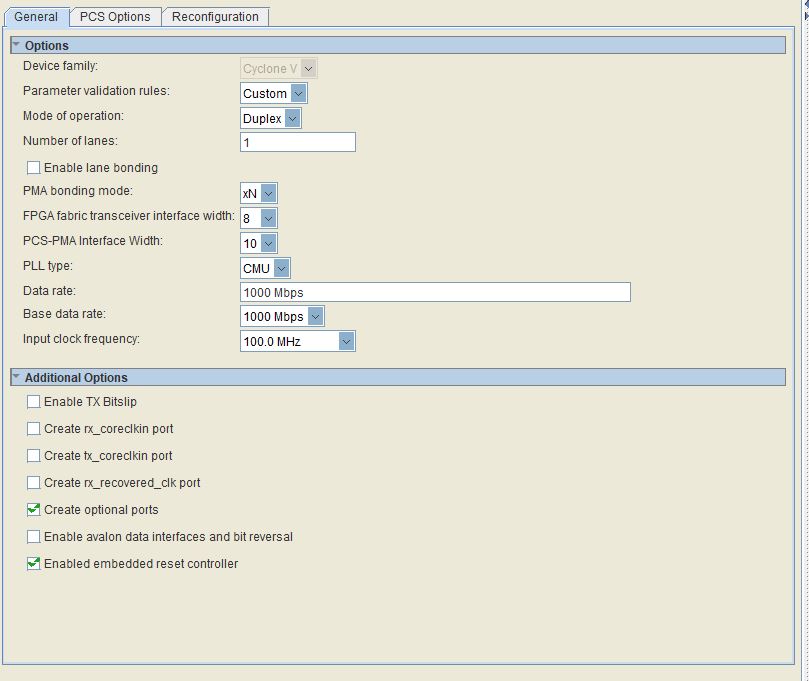
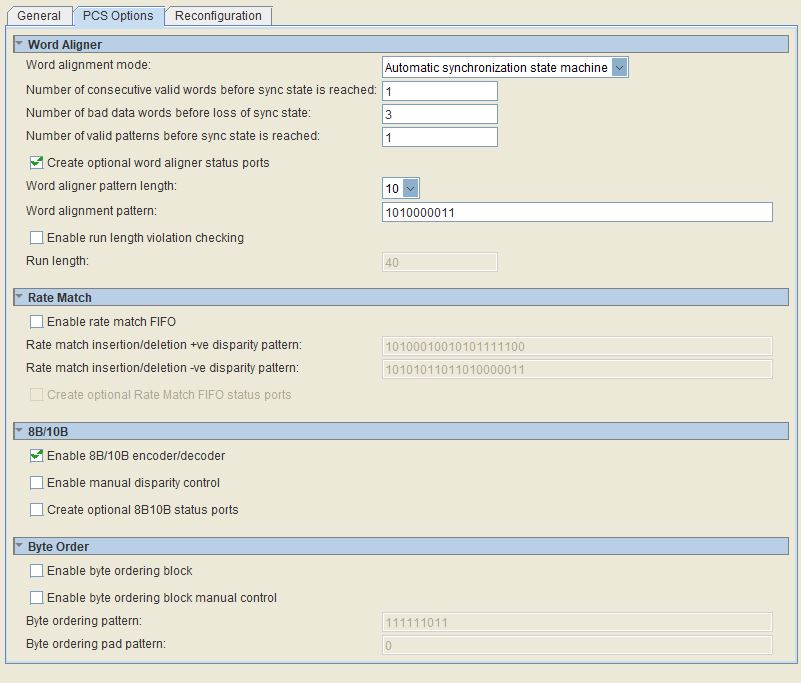
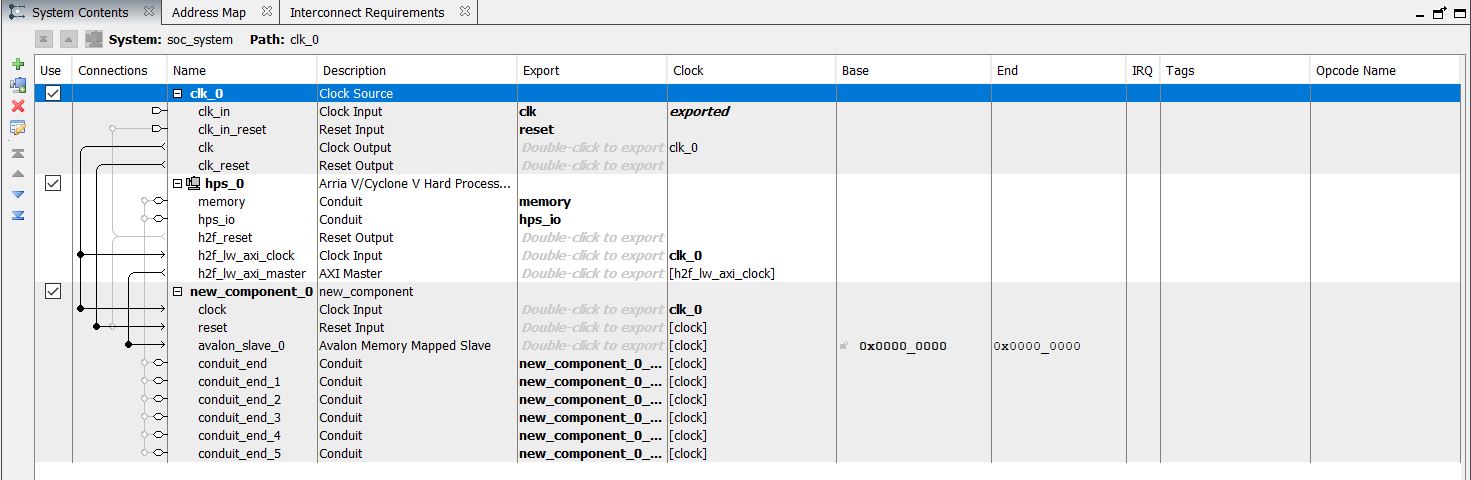
Here is the HDL code for that top level register module that I made:
module xcvrputtysim(
input clk,
input reset,
input read,
output [7:0] readdata,
output tx_serial_data,
input rx_serial_data,
output rx_syncstatus,
output tx_serial_data1,
input rx_serial_data1,
output tx_clkout
);

reg [7:0] Regreaddata;
wire [7:0]rx_parallel_data;
wire outclk;

assign readdata=Regreaddata;

xcvrtop u8(
.clk(clk),
.reset(reset),
.tx_serial_data(tx_serial_data),
.rx_serial_data(rx_serial_data),
.rx_parallel_data(rx_parallel_data),
.rx_syncstatus(rx_syncstatus),
.tx_serial_data1(tx_serial_data1),
.rx_serial_data1(rx_serial_data1),
.tx_clkout(tx_clkout)
);
always @(posedge tx_clkout)
	begin
		if(reset)
			begin
				Regreaddata<=0;
			end
		else if(read)
			begin
				Regreaddata<=rx_parallel_data;
			end
	end
endmodule
Can you please help me what can I do? My main system clock (clk) is 50 MHz. I tried but on putty terminal I am seeing strange words like 1129933, 85609, 998812 etc etc. Here is my C code that I tried for HPS:
#include <stdio.h>
#include <unistd.h>
#include <stdlib.h>
#include <stdint.h>
#include <fcntl.h>
#include <sys/mman.h>
#include <sys/types.h>
#include <sys/stat.h>
#include "C:\altera\15.1\embedded\ip\altera\hps\altera_hps\hwlib\include\hwlib.h"
#include "C:\altera\15.1\embedded\ip\altera\hps\altera_hps\hwlib\include\soc_cv_av\socal\socal.h"
#include "C:\altera\15.1\embedded\ip\altera\hps\altera_hps\hwlib\include\soc_cv_av\socal\hps.h"
#include "C:\altera\15.1\embedded\ip\altera\hps\altera_hps\hwlib\include\soc_cv_av\socal\alt_gpio.h"
#include "D:\masterarbeit3\XCVRHWPutty - Copy\hps_0.h"

#define REG_BASE 0xFF200000 /*LWFPGA SLAVE Address*/
#define REG_SPAN 0x00200000

volatile unsigned int *reg_addr; /*this is the pointer that writes to the register. This is our write input*/
void* virtual_base; /*pointer to open device memory file*/

int main ()
{

int fd = EXIT_FAILURE;

fd=open("/dev/mem",(O_RDWR|O_SYNC));
if (fd < 0) {
		perror("open");
		exit(EXIT_FAILURE);
			}
printf("fd is ok\n");

virtual_base=mmap(NULL,REG_SPAN,(PROT_READ|PROT_WRITE),MAP_SHARED,fd,REG_BASE);
printf("virtual base pointer to open device memory file is ok\n");

reg_addr = (unsigned int *) (virtual_base+NEW_COMPONENT_0_BASE); /*accessing base address of register*/
while(1)
{
printf("pointer value is %d\n", *reg_addr);
}
return 0;
}